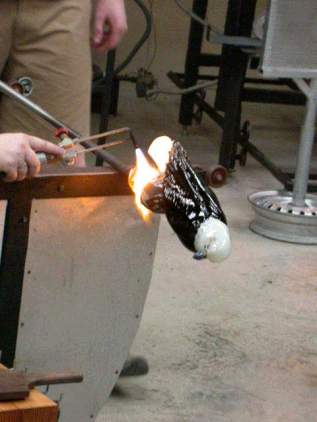
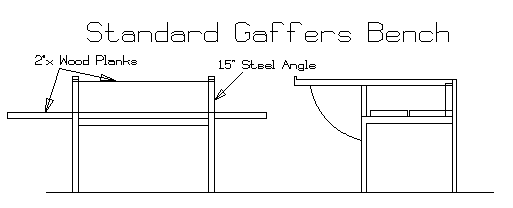
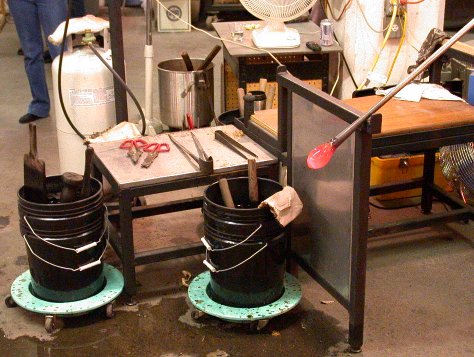
 A glass worker's bench is most commonly a steel framed
long armed chair with a wooden seat that extends beyond
the arms on both sides. Below the arms are metal shields
to protect the legs of the worker from the heat of the
glass. The pipe or punty is placed on the arms and rolled
out and back to keep the glass in a smooth round shape
while working it. On the extended seat [or on a small table the same
height, in picture below right] are placed metal
tools, which may also hang on nails driven in the edge,
and behind the seat are often buckets of water holding
blocks and wooden tools. Since sliding tools
must be waxed (jacks ) and gripping tools must not (tweezers,
shears), the waxed tools are placed tips to one edge, the
unwaxed to the other. 2004-07-26 A glass worker's bench is most commonly a steel framed
long armed chair with a wooden seat that extends beyond
the arms on both sides. Below the arms are metal shields
to protect the legs of the worker from the heat of the
glass. The pipe or punty is placed on the arms and rolled
out and back to keep the glass in a smooth round shape
while working it. On the extended seat [or on a small table the same
height, in picture below right] are placed metal
tools, which may also hang on nails driven in the edge,
and behind the seat are often buckets of water holding
blocks and wooden tools. Since sliding tools
must be waxed (jacks ) and gripping tools must not (tweezers,
shears), the waxed tools are placed tips to one edge, the
unwaxed to the other. 2004-07-26 |
The minimum practical requirements seem to be a steel top surface with stops at the end to keep the pipe from rolling off. For the seated version, the rails need only come back to tummy location and be out to arms reach for the tallest user when seated leaning forward a bit. |
|
Some workers omit the bench and its arms and work glass on ball bearing rollers like a yoke or threading stand.
|
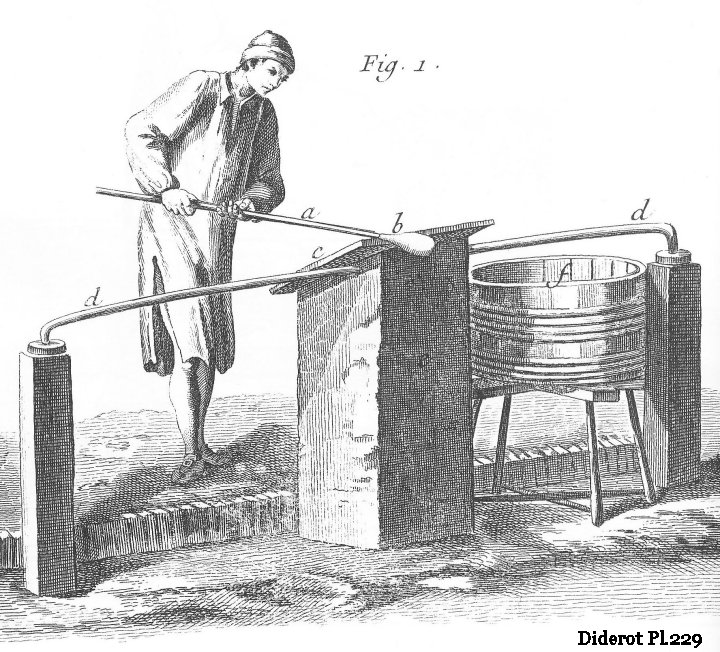 Dederot's
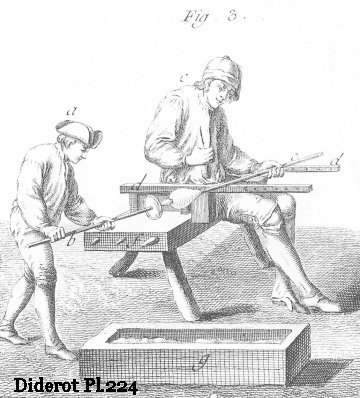
Encyclopedia shows several different working methods, including a goblet maker
at a bench much like the one up top. Bottle makers work standing, using a
mold shape in the floor. This image shows the gaffer necking the bottle on
the back edge of the marver plate which is used in the next plate during
inflation and later during finishing. The pipe to the right is used to
support the blow pipe during cooling with water in the tub. The other is
used during inflation rather than rolling the pipe on the sharp edge of the
marver plate. 2010-02-25 (click to enlarge for more detail) Dederot's
Encyclopedia shows several different working methods, including a goblet maker
at a bench much like the one up top. Bottle makers work standing, using a
mold shape in the floor. This image shows the gaffer necking the bottle on
the back edge of the marver plate which is used in the next plate during
inflation and later during finishing. The pipe to the right is used to
support the blow pipe during cooling with water in the tub. The other is
used during inflation rather than rolling the pipe on the sharp edge of the
marver plate. 2010-02-25 (click to enlarge for more detail) |
 |
|
|
|
|
|
|
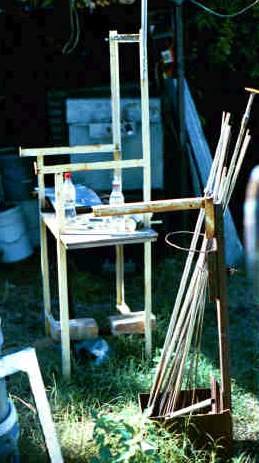 Having a bad
back, I stand all the time rather than getting up and down, so I use
Having a bad
back, I stand all the time rather than getting up and down, so I use
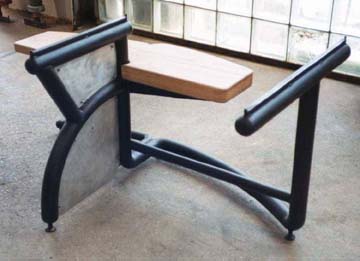 This is a perfectly utilitarian bench, level arms, seat for a right handed
person, leveling feet underneath, shield, that is absolutely sexy and neat.
This is a perfectly utilitarian bench, level arms, seat for a right handed
person, leveling feet underneath, shield, that is absolutely sexy and neat.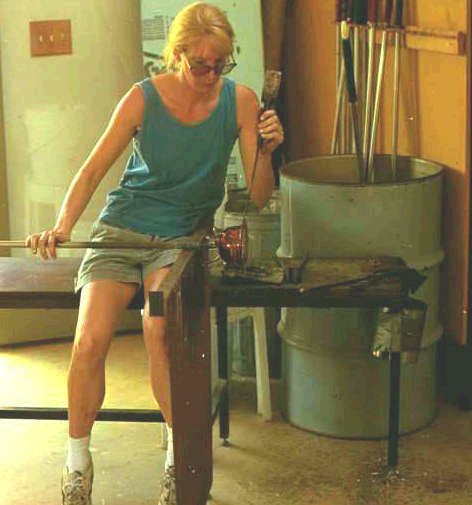 Marty Johnson prefers a bench with a
higher and angled seat so she can get on and off it quickly, her heels do
not touch the floor when she is seated. She is also ambidextrous and
works wet on the right end and dry on the left. 2003-11-14
Marty Johnson prefers a bench with a
higher and angled seat so she can get on and off it quickly, her heels do
not touch the floor when she is seated. She is also ambidextrous and
works wet on the right end and dry on the left. 2003-11-14